
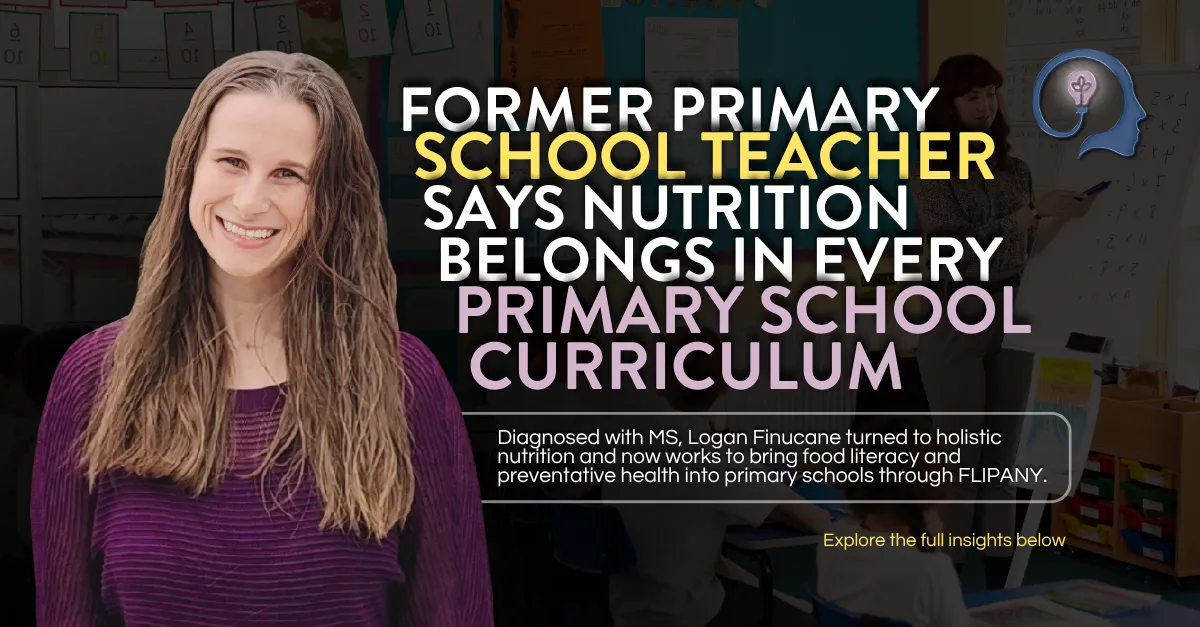
Why This Former Primary School Teacher Says Nutrition Belongs in Every Primary School Curriculum
Logan Finucane used to teach kindergartners how to count to 10.
Now, she teaches others what’s inside what they are eating.
For over a decade, Logan worked as a primary school teacher. But after waking up one morning completely blind and later being diagnosed with multiple sclerosis, her entire world shifted. Doctors prescribed medication after medication, but instead of healing, the side effects kept piling up: brain fog, bladder incontinence, blurred vision, and worsening mobility.
“I realized I was losing more from the medications than from the disease itself,” Logan shared.
As her condition worsened, so did her ability to teach. Until one day, a friend handed her a gut health protocol, and everything began to change.
Brain fog lifted. Her energy returned. Speech improved. And most importantly, she found a new sense of purpose: teaching people, especially children, how nutrition and lifestyle can prevent the suffering she endured.
Today, Logan is a nutrition educator with the nonprofit FLIPANY, helping kids understand the “why” behind their food. And she believes that if we start early enough, nutrition education isn’t extra, it’s essential.
When Teaching Becomes Unsustainable
Before she became a nutrition educator, Logan was a devoted primary school teacher. She loved the classroom. She loved her students.
“I used to teach K–2 and pre-K,” she said. “I had been around kids since I was 16. But eventually, I just couldn’t keep up physically. I started losing dexterity in my right hand. I couldn’t write on the board anymore. Everything slowed down.”
What started as fatigue turned into something terrifying: one morning, Logan woke up completely blind.
Her doctors scrambled to explain it, first allergies, then migraines, until MRIs revealed lesions on her brain and spine. The diagnosis: Multiple Sclerosis (MS). Suddenly, the electric waves through her body, the speech issues, and the numbness all made sense.
But the solutions offered didn’t feel like healing.
“I went on medication, but the side effects were awful,” Logan said. “My speech was worse. My eyesight blurred under fluorescent lights. I had bladder issues. I felt like I was living half a life.”
Teaching, once a source of purpose, became a source of pain. Logan realized she had to leave the classroom. But she wasn’t ready to stop teaching; she just needed a new subject.
From Medication to Mind-Body Healing
For years, Logan did what most patients do: she trusted the prescriptions. She cycled through medications meant to manage MS, but they came with a cost. Her liver, her eyesight, her speech were all suffering. And the longer she stayed on the pills, the less like herself she felt.
Then her insurance lapsed. The medication stopped. And something surprising happened.
“I noticed my vision started coming back,” she said. “My speech was clearer. I felt better without the meds.”
That’s when Logan decided: no more. She told her neurologist she wanted to manage MS naturally, through food, lifestyle, and holistic support. He offered her the “pillars of wellness”: sunlight, movement, and removing gluten and soy. She took it further.
A friend introduced her to gut health protocols through Arbonne, prebiotics, clean protein shakes, and plant-based nutrients. It wasn’t a miracle. It was science.
“It changed everything,” Logan said. “My energy came back. The brain fog lifted. I could walk again. I could talk again. For the first time in years, I felt like myself.”
It was the beginning of a new chapter, not just in her health, but in her purpose.
Why She Teaches Nutrition Now Instead of Academics
After over a decade in the classroom, Logan had mastered the art of primary education. But chronic illness taught her something school never did: the foundational role of nutrition in preventing disease and in creating a life of vitality, not just survival.
“If I had learned this earlier,” she said, “I don’t believe I would be in the position I am today.”
It’s not that Logan doesn’t believe in school. She believes in teaching kids what really matters. For her, that meant leaving the traditional classroom and stepping into a new role: nutrition educator with the nonprofit FLIPANY (Florida Introduces Physical Activity and Nutrition to Youth).
She now spends her days in after-school programs, teaching kids how to read recipes, prepare real food, and understand how their bodies work. From sugar spikes to food dyes, inflammation to gut health, Logan teaches the science behind why healthy habits matter.
And she’s not just teaching students, she’s reaching parents, too.
“So many adults still don’t know this stuff,” she said. “We hand kids tablets and fast food without understanding how it affects their brains, their behavior, and their future health. Someone needs to start the conversation.”
The Missing Subject in Schools is Teaching Kids How to Heal Themselves
She knows firsthand how poor nutrition, unchecked stress, and a lack of education can lead to chronic illness. And she knows that information alone isn’t enough. What kids (and adults) really need is an understanding of the why behind it all.
“I love teaching science. I want people to understand how everything in the body is connected, that gut health affects brain health, that inflammation leads to disease, and that food is either healing you or hurting you,” Logan emphasized.
It’s why she believes nutrition education should be integrated into the school system, not just as a side program, but as a fundamental part of how we teach kids to care for themselves.
She’s also deeply passionate about mental health, especially among young people. In her view, food and feelings are more connected than most realize. Processed diets, artificial ingredients, and excessive screen time don’t just impact physical health; they affect emotional resilience, attention span, and self-regulation.
“Most kids don’t know why they feel the way they do,” Logan said. “And if we never teach them that connection, they grow into adults who still don’t know. That’s what I’m trying to change.”
To the Health & Wellness Industry: “Don’t Wait for Credentials to Start Caring”
Logan Finucane didn’t set out to be a wellness educator. She was a primary school teacher, someone who believed in the power of knowledge to shape young minds. But when her own health began to unravel, and conventional medicine offered side effects instead of solutions, she realized something deeper:
Healing can’t wait for permission.
Today, Logan has a powerful message for the health and wellness industry, especially for those who are just starting out or who feel like they’re not “qualified” enough.
“You don’t need a title to care about people,” she said. “You need to show up, do the work, and share what you’ve learned with humility and heart.”
She’s seen firsthand how the system sidelines nutrition, mental health, and root-cause education in favor of fast fixes and symptom suppression. And she’s calling for a shift, one that puts prevention, education, and early intervention at the center of the conversation.
↳ Make nutrition education accessible, especially to kids.
↳ Acknowledge how emotional, mental, and physical health are intertwined.
↳ Support educators and practitioners who’ve walked the path themselves, not just the ones with credentials.
“There are people out there with degrees who never had to fight for their health,” Logan said. “And there are people like me, who had to learn the hard way, who are now trying to prevent others from falling into the same trap. Both perspectives matter.”
She also wants emerging health entrepreneurs to understand this:
Consistency is the quiet superpower.
There is no shortcut. “Doing the work consistently, it’s part of the journey,” Logan said. “That applies to healing, to business, to education. Nothing transforms overnight.”
And above all: everything is connected.
What we eat affects how we think.
How we manage stress affects how we show up.
And nutrition isn’t just a diet trend; it’s a foundational tool in balancing the body, brain, and spirit.
In a world overwhelmed with information and undernourished by wisdom, Logan’s story is a reminder:
The wellness revolution doesn’t need more experts. It needs more advocates.
People are willing to tell the truth.
People are willing to show up before they’re ready.
People are willing to change the system, not just operate inside it.
The Future of Healthy Generations Starts in the Classroom
Logan Finucane’s story isn’t just one of personal healing; it’s a blueprint for systemic change.
She’s living proof that when we shift our priorities from reactive medicine to proactive education, we don’t just help individuals heal; we change the trajectory of entire communities.
Her vision isn’t to replace primary education; it’s to expand it. To make nutrition, mental health, and lifestyle awareness just as foundational as reading and math.
To help kids and the adults guiding them understand that well-being is a learned skill.
And if we teach it early, we might just prevent an entire generation from ever needing to “recover” in the first place.
Do You Have a Mission, Method, or Story Worth Sharing?
At MBNews, we spotlight purpose-driven practitioners, educators, and founders who are building the future of health, one bold step at a time.
Do you have:
↳ A transformational story?
↳ A method that’s making a difference?
↳ A message this industry needs to hear?
We want to feature you.
Apply to be profiled in an upcoming MBNews story:
📩 Apply for an MBNews Feature → www.mbnews.live