
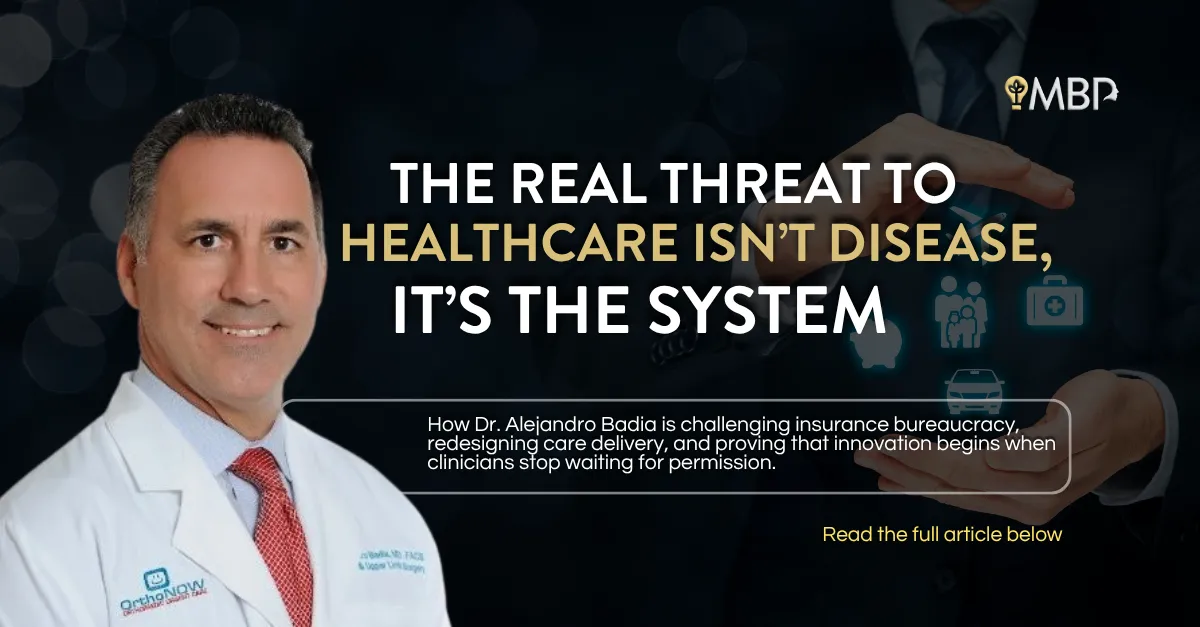
Why Dr. Alejandro Badia’s Bold Vision Could Save U.S. Medicine and What Doctors Must Do Now
The Real Healthcare Emergency No One’s Talking About
The ER wasn’t built for chronic pain. The insurance system wasn’t built for innovation. And American healthcare, as it stands today, wasn’t built for the people it claims to serve; it’s built for profit, bureaucracy, and delay.
Dr. Alejandro Badia knows this not in theory, but in practice. He’s spent over two decades inside the system, navigating it as a top orthopedic hand surgeon, only to realize that the biggest threat to patient care isn’t lack of talent or technology, it’s the very structure of care delivery itself.
From watching his own patients suffer through unnecessary delays due to insurance red tape to investing in state-of-the-art diagnostic and surgical tools that insurance companies refuse to reimburse, Dr. Badia has seen it all. And instead of walking away, he doubled down.
His story isn’t just about hand surgery. It’s about resilience, vision, and the refusal to accept a broken system as the status quo. He’s built his own walk-in orthopedic centers, written a book calling out the system’s deepest flaws, and launched an international practice to prove that care can be faster, smarter, and more human.
He’s not just calling out the crisis. He’s building the solution.
And now, he wants the rest of the medical world to do the same.
From His Grandmother’s Hands to Global Impact
Before he became one of the world’s leading hand surgeons, Dr. Alejandro Badia was just an eight-year-old boy watching his grandmother suffer. She had rheumatoid arthritis, a condition that left her unable to do the things she loved, like sewing. One day, the family visited a hand surgeon in New York who was performing what was then an experimental procedure to realign deformed fingers.
That moment stayed with him. Not just the science, but the hope.
“I realized early on that I was interested in science,” said Dr. Badia. “But seeing that surgeon work on my grandmother’s hands, hands that had cared for me, it planted a seed.”
Raised by a lineage of Cuban physicians and nurtured by grandparents who supported him through his early years, Dr. Badia’s destiny took shape. He earned a degree in physiology at Cornell, studied medicine at NYU, and eventually specialized in the most intricate and underappreciated parts of the human body, the hands.
Why hand surgery? Because, as he puts it, it’s the most diverse specialty in medicine. “It’s the neurosurgery, the orthopedics, the plastic surgery, the tumor surgery, the pediatric surgery,” he explained, “but from the elbow down.”
That complexity didn’t scare him; it pulled him in. And over time, it gave him a unique vantage point on a broken healthcare system that treats the human body like parts on an assembly line.
From the beginning, Dr. Badia was wired for precision, purpose, and reform. What he didn’t know then was just how much innovation and resistance he would face along the way.
Building a System That Works, Not Just Operates
As his clinical skills sharpened, so did his frustration with the healthcare system. Patients were waiting too long. Insurance red tape delayed simple diagnostics. Care was fragmented, inefficient, and painfully slow.
So, Dr. Badia did what few physicians are willing or able to do. He built something better.
In 2008, he founded the Badia Hand to Shoulder Center, a fully integrated orthopedic hub that included surgery, rehab, and imaging, all under one roof. No more multi-week waits for an MRI. No more bouncing between care facilities. Just smart, seamless service.
But he didn’t stop there.
He soon launched OrthoNOW, a disruptive walk-in orthopedic care model that bypasses traditional gatekeepers like ERs and primary care. Patients could come in for everything from knee pain to back issues and get expert orthopedic care on the spot.
“We stopped calling it ‘ortho urgent care,’” said Dr. Badia. “Because most of our patients didn’t have injuries, they had chronic pain. Our data showed the number one diagnosis was right knee pain.”
OrthoNOW proved there was a hunger for this kind of access to care that meets people where they are. But disrupting an industry run by bureaucracies wasn’t easy.
Insurance companies didn’t reward efficiency. Referrals were difficult. And too often, patients still believed that the best care had to come from a big hospital or traditional pathway.
Meanwhile, international patients, who often pay out of pocket, flocked to his Miami clinic.
“I built an international practice because outside the U.S., people are used to paying directly for faster, better care,” Dr. Badia noted. “They’ll fly in from Ecuador or Mexico City, because they know they’ll be treated quickly.”
Behind it all is his relentless drive to prove that there’s a better way.
“I made a huge investment to build this. MRI, ultrasound, surgery suites, rehab—it’s all here. But the system doesn’t reward that. It resists it.”
Still, he keeps building. Because for Dr. Badia, this isn’t just about practice growth. It’s about a full-blown reimagination of how healthcare should work.
Bureaucracy Before Patients. The Cost of Delayed Care
It didn’t hit Dr. Alejandro Badia in medical school. Not during his time at Cornell. Not even at NYU, where he earned his medical degree. The realization that American healthcare was deeply flawed came once he stepped into private practice, when he saw how the system truly worked from the inside.
“I realized in the first few years of practice that we were being paid so little for our services, the only way to stay afloat was to see a massive volume of patients,” said Dr. Badia. “That’s when it hit me—this isn’t sustainable.”
The numbers told the story. Despite skyrocketing premiums and massive hospital costs, doctors were being squeezed—forced into a volume-over-value model that left little room for quality care. Insurance companies were the culprits, acting as gatekeepers and dictating how and when care could be delivered.
“I had a patient with severe shoulder pain. My MRI machine was right in the next room. But because of Medicare restrictions, I couldn’t scan her. She had to leave, get the scan elsewhere, and come back days later in pain the whole time. That’s not healthcare. That’s bureaucracy,” Dr. Badia explained.
He had already invested in a fully integrated center with MRI, rehab, surgical suites, and diagnostics all under one roof, but the system punished that innovation. Instead of rewarding streamlined, cost-effective care, insurers delayed it.
Even when doctors followed the rules, they encountered another barrier: pre-authorization. “We’re literally waiting for someone with no clinical background to approve a test or procedure,” Dr. Badia said. “That delay? It can turn a manageable condition into a costly, chronic crisis.”
That’s why he coined the mantra: Right clinician, right time.
Early, expert care prevents expensive complications. And more importantly, it eases the patient’s suffering. But the current model prioritizes billing codes over biology. Revenue over results.
“Healthcare shouldn’t be dictated by someone at a desk who’s never examined a patient,” he said. “Yet that’s exactly what’s happening.”
These weren’t isolated incidents. They were everyday obstacles. They were the reason Dr. Badia knew something had to change, not just in one practice, but across the entire system.
And so he spoke up. Loudly.
With a book. A podcast. Public speaking. And a relentless campaign to expose the truth: that America’s healthcare model isn’t broken by accident. It’s broken by design. And it’s up to clinicians to fix it before it fails completely.
“People are dying because of system delays,” Dr. Badia warned. “This is a life and death matter. And we’re running out of time.”
Building What Healthcare Should Be: Results That Speak Volumes
Dr. Alejandro Badia didn’t just critique the system. He built a better one.
With OrthoNOW, he reimagined what orthopedic care could look like: walk-in access to specialists, on-site diagnostics, surgery suites, and rehabilitation all under one roof. No more back-and-forth between facilities. No more waiting weeks for tests or treatment plans. Just efficient, expert care on demand.
The result? A model that actually works. For patients. For doctors. And for outcomes.
Seventy percent of walk-ins at OrthoNOW present with pain, not acute trauma. This data flipped the script. Instead of focusing only on emergency injuries, Dr. Badia’s team prioritized early intervention for chronic issues like shoulder and knee pain.
Patients didn’t just get better, they got better, faster.
“I realized patients were flying in from Latin America to get the kind of care they couldn’t access even in the U.S.,” Dr. Badia said. “And they were willing to pay out of pocket, just to avoid the delays and denials they experienced in traditional systems.”
This wasn’t concierge medicine. It was common sense, finally applied to healthcare.
By stripping out insurance bottlenecks, Dr. Badia proved that high-quality care doesn’t have to be high-cost. It has to be accessible. And accountable.
His model is now being scaled, with OrthoNOW locations expanding and attracting attention from healthcare entrepreneurs. Redwood Advisors acquired a majority stake, a strategic move to grow the model without compromising its mission.
Meanwhile, Dr. Badia continues to serve an international clientele of patients who refuse to wait for relief. His integrated care model doesn’t just treat injuries. It prevents escalation. It preserves mobility. It restores quality of life.
It’s what healthcare should have been all along
Surgeon to System Shaker: Advocacy That Matters
Frustrated by the silence around healthcare’s biggest problems, he took matters into his own hands, starting with the release of his book, Healthcare from the Trenches. It’s a raw, unfiltered look at the realities doctors and patients face every day, told not just through his lens, but through the voices of 27 other healthcare professionals.
Available on Amazon and Google Audio, the book offers a rare perspective missing from the national debate. What it’s actually like to deliver care in a system designed to delay it.
He then launched the Healthcare from the Trenches podcast, inviting physicians, policymakers, and public health leaders to unpack the deeper causes of dysfunction. While the podcast is currently on hiatus, the message is still loud and clear: systemic change starts with honest conversation.
And he’s not waiting for permission to speak up. Dr. Badia contributes regularly to platforms like SoMeDocs and LinkedIn, aiming to reach both practitioners and patients with practical, frontline insight.
“The public needs to be educated,” he emphasized. “And doctors need to stop being afraid of telling the truth.”
In a world where soundbites dominate and lobbyists lead the charge, Dr. Badia’s voice cuts through the noise not with anger but with action. Not just with criticism, but with credible solutions.
Collaboration Is the Cure: A Message for Fellow Practitioners
Dr. Badia’s message to other healthcare professionals is simple: stop working in silos.
“If we want to fix this system, we have to stop acting like competitors and start acting like collaborators,” he said.
That means allopathic doctors working with chiropractors. Specialists referring to holistic providers. Surgeons are staying open to therapies beyond their scope.
“At OrthoNOW, we refer patients to a chiropractic physician in our building when that’s what they need,” he shared. “It’s about the patient, not your ego.”
What’s Next? Building Beyond the Operating Room
These days, Dr. Badia is still in the OR but his mission has expanded far beyond the scalpel. As OrthoNOW enters a new chapter under Redwood Advisors, he’s taking a step back from daily operations to focus on what matters most: impact.
He’s advising on outpatient care strategies, championing clinician-led innovations, and writing for platforms like SoMeDocs and LinkedIn. He’s not just treating patients—he’s shaping the future of medicine.
And while he may not be writing another full-length book, his voice is louder than ever.
“If you email me through DrBadia.com, you’ll probably hear back from me personally,” he said. “I believe in accessibility. That’s what good medicine is all about.”
For a system built on delay, denial, and disconnection, Dr. Badia is offering something radical:
Direct access. Real solutions. And a future where healthcare works for everyone.
Dr. Badia believes the future of medicine depends on breaking old paradigms. Not just in how care is delivered, but how doctors think.
He credits his success not just to expertise, but to curiosity. He still attends conferences every month, often as a speaker, but always as a learner.
“I’m a sponge,” he said. “If you stop learning, you stop leading.”
For doctors who want to drive real change, the call is clear: learn more, judge less, and build a system that treats patients not just symptoms.
Are You the Next Voice Redefining Healthcare?
In a system where the loudest voices often belong to those furthest from the front lines, Dr. Alejandro Badia is a rare kind of disruptor. He’s not theorizing change, he’s building it, brick by brick, surgery by surgery, patient by patient.
His story is a blueprint for practitioners who refuse to accept the status quo. It’s a reminder that courage in medicine isn’t just in the operating room, it’s in the conversations we dare to start, the systems we choose to challenge, and the care we insist on giving.
Dr. Badia’s journey is a mirror for every healthcare professional who has felt the weight of bureaucracy, and every patient who has waited too long for help they should have received right away. It’s proof that change isn’t just possible, it’s already happening.
So we ask you: Has this story sparked something in you? Do you know a provider, practitioner, or wellness innovator who’s challenging the norm?
We’re always looking to spotlight bold voices at the intersection of healing and disruption.
Join us at MBNews as we tell the stories that need to be heard, because the future of medicine depends on it.