
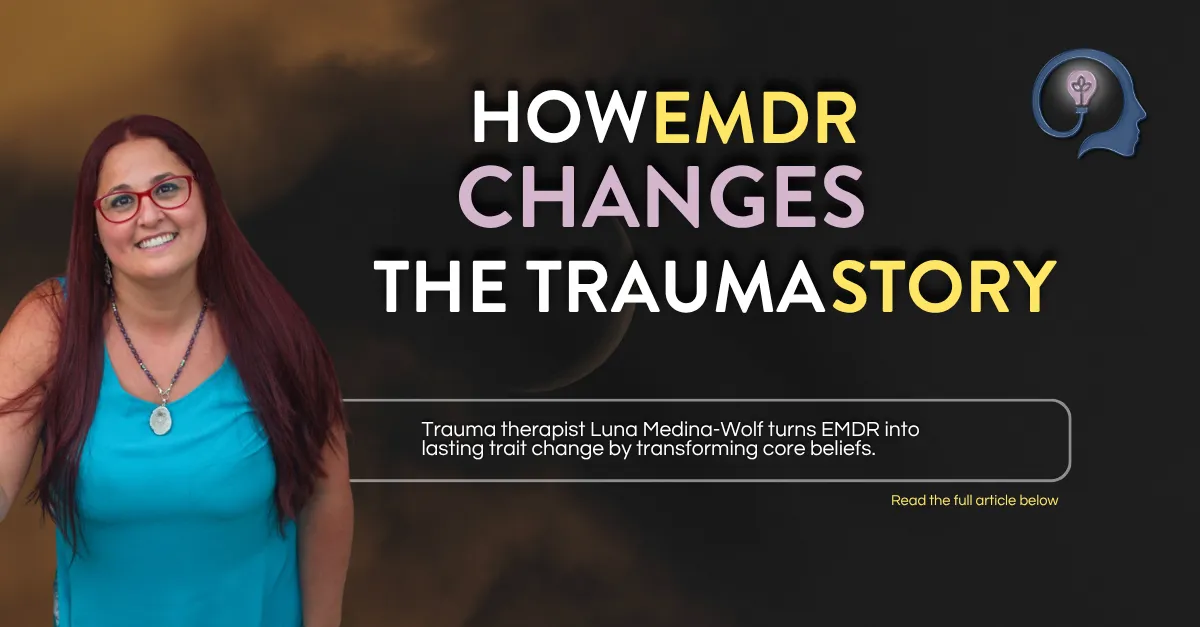
Domestic Abuse Survivor to Healer. How EMDR Rewrites Trauma
When Healing Tools Don’t Go Deep Enough
So many survivors usually undergo these therapies: journaling, mindfulness, coping skills, and talk therapy. They feel better until a smell, a sound, or a tone of voice drags the past into the room. The day is fine; the nervous system isn’t.
Clinicians know the heartbreak: symptoms loop, beliefs calcify (I’m not safe. I’m not enough.), and people conclude they’re “too broken” for lasting change. We’re soothing states while the memory network, where trauma lives, keeps firing.
Luna Medina-Wolf built a different path. Emancipated at 16 with the help of a social worker, she now leads Helping Moon Counseling, where EMDR isn’t a trendy add-on; it’s the spine of care. “With EMDR… we create what we call a trait change,” said Luna Medina-Wolf. This is the story of a girl who escaped violence, the clinician she became, and the model any mission-driven practice can learn from.
The Moment That Changed Everything
The day a judge changed a life and set a mission in motion.
Luna’s childhood wasn’t quiet; it was carefully managed. She made top grades, volunteered, and kept the peace. The chaos didn’t stop, but she learned to be “good,” so she wouldn’t add to it. Behind closed doors, abuse targeted her mother. Luna spoke up when she could. No one listened.
At sixteen, after returning late from a community event, with the director personally vouching at the door, her father waited until the door shut, then beat her for the first time. She climbed out the window that night and didn’t look back. The next day at school, a social worker teaching a domestic-abuse workshop noticed a teenager in long sleeves on a hot day, a student who couldn’t sit still for the lecture. She slipped Luna a card.
“I locked myself in the room and called her,” said Luna Medina-Wolf.
What followed was a procession before a judge: social worker, teacher, mother, father, and Luna, each alone, each asked for the truth. Luna begged her mother to stop protecting a lie. This was the moment.
The judge granted emancipation and looked at Luna’s father: Your daughter will make this world better, not thanks to you, but because of you. Luna decided to spend the rest of her life earning that sentence.
She thought she’d work only with domestic-abuse survivors. She volunteered for years at a shelter. Then, a week before grad-school placements, the internship she’d built her life around fell through. Another door, unexpectedly, opened.
Finding Purpose in the Unplanned Path
When mission meets method, word-of-mouth is enough.
A classmate mentioned a last-minute opening at a substance-use facility. It wasn’t what Luna wanted. She took it, then fell in love with the work. Underneath cravings, she kept finding the same root: trauma.
Ten years later, in private practice, she encountered EMDR. She walked in skeptically.
“I heard about this thing that supposedly heals people… it sounded like a lot of BS,” she thought.
By the end of training week, eight months pregnant and riddled with guilt about complications, she chose her own shame as the target. The shift was visible.
“My husband said, ‘Something is different; you look calmer.’ I was,” said Luna Medina-Wolf.
That night, she brought EMDR to a client in a substance-use program. He later reunited with his daughter. They still keep in touch.
From that conviction grew Helping Moon Counseling, now 24 clinicians and 5 interns in 10 years, built without ads or funnels. The practice draws steady referrals because it delivers what people actually feel: change that lasts.
What sets Helping Moon apart:
EMDR-First, Not EMDR-Eventually. Most clinicians are trained; many pursue certification. Supervision and consultation are non-negotiable.
The 8-Phase Protocol with Soul. History, resource development, carefully titrated processing, installation, and closure, paced by the client’s nervous system, not a schedule.
Outcome: Trait Change. Not just “I feel better today,” but “I am different now.”
“Many therapies offer state change,” she said. “EMDR offers trait change.”
Depth Over Hype, Building a Practice That Heals
Saying no to noise, and yes to depth.
Some turning points are forced (a lost internship); some are chosen. Luna chose to make quality her growth strategy.
She remembered how easily a well-meaning system had missed the truth when she was a child. She refused to replicate that in her clinic. If a client’s story fragmented in intake, she didn’t push through to stay “on track.” She paused.
“Let’s notice how you’re feeling right now,” said Luna Medina-Wolf. “We’ll ground before we go deeper.”
Clinically, the cornerstone became dual attention, one foot safely planted in the present, one carefully stepping into the past, activated with bilateral stimulation (eye movements, tactile buzzers, or taps).
“We create a state with one foot in the present and one in the past,” “Grounded, safe, and deep.”
As a founder, she faced the usual temptations: paid ads, flashy campaigns, quick expansion. She passed. Helping Moon would grow the way secure attachment forms: slowly, honestly, with enough support in the system to hold what emerges.
She poured energy into her team: consultation groups, case conferences, a pipeline toward EMDR certification, and her own training journey.
“I want them certified, not just trained, because without continued consultation, you lose touch and confidence,” she said.
And the market responded. Not to slogans, to results.
When the belief changes, it transforms lives
Ask Luna for outcomes, and she’ll start with people, not metrics.
There’s the father who processed a core network of shame and reunited with his daughter. The client whose elevator phobia resolved in six to eight sessions. The survivor who stopped flinching at every raised voice because her body finally believed the sentence her mind had rehearsed for years: I am safe now.
“For single-event phobias, six to eight sessions can clear it,” said Luna Medina-Wolf. “For complex PTSD, it takes longer, but it’s still faster than anything else I’ve seen.”
Why it works:
Memory Reconsolidation with Care. EMDR reopens a memory network and links in adaptive information, replacing conclusions formed in fear (I’m stupid, I’m unworthy) with true updates from the present.
Window of Tolerance First. Phase 2, resource development, isn’t optional. It’s the container that prevents re-traumatization.
The System Learns Safety. The body stops responding as if the worst moment is still happening.
Inside the practice, outcomes ripple outward.
Capacity with Integrity. A 24-clinician team means more survivors get timely care without sacrificing depth.
Reputation as Gravity. Physicians, programs, and past clients refer because the work endures.
Culture of Mastery. As Luna moves into the final stage of becoming an EMDR Trainer, Helping Moon becomes a training ground, raising the bar for the region.
Lessons for a New Generation of Therapists
If we want different outcomes, we must work differently.
Luna’s dream isn’t modest.
“My dream is that every therapist will be trained in EMDR one day,” said Luna Medina-Wolf. “It’s so effective; why wouldn’t you want this under your belt? ”
Five takeaways for clinicians, clinic owners, and trauma-informed leaders:
Treat the root, not just the day.
Coping skills soothe states; EMDR transforms traits.Make safety the protocol, not the preamble.
Grounding and resourcing come first, last, and always, especially with complex trauma.Let outcomes be your marketing.
Helping Moon reached 24 clinicians with zero ad spend. Depth scales trust.Invest in consultation like it’s payroll.
Confidence is a clinical outcome. Supervision keeps it strong.Honor the client’s pace.
When we regulate timing to the nervous system, the nervous system finally learns time has passed.
“It’s not about controlling emotions,” said by Luna Medina-Wolf. “It’s about feeling safe enough to feel them.”
The Future of Trauma Care
Luna is finishing her path to become an EMDR trainer. She volunteers with EMDR HAP, the humanitarian nonprofit arm of the EMDR world, and continues building a certification pipeline inside Helping Moon so clinicians don’t stop at training; they integrate it.
She imagines a region where any survivor can access trait-level trauma care. She imagines a profession where EMDR is standard, not a specialty. She imagines fewer teenagers needing long sleeves in summer.
“We met the demand by focusing on the work,” said Luna Medina-Wolf. “That’s the plan going forward, too.”
Freedom is more than just a feeling
Because freedom isn’t a feeling; it’s a nervous system that knows it.
At sixteen, Luna stood in a courtroom while a system finally told the truth out loud. Today, she sits in therapy rooms teaching bodies to learn the same truth on the inside.
EMDR won’t erase what happened. It will change what it means now. It will move a belief from I’m not safe to I survived to I am safe now.” That shift is why survivors sleep, why families reunify, and why clinicians stay in love with the work.
For founders and practitioners, Luna’s blueprint is disarmingly simple: choose depth, back it with evidence, build a team that practices what it teaches, and let integrity do your marketing. That’s how a practice becomes a movement.
Because healing isn’t about quick fixes; it’s about honest tools that work. And when a survivor becomes the trainer who teaches those tools, a whole community breathes easier.
Join the MBNews Movement
Join the MBNews community as we amplify clinicians and founders who are changing mental health with evidence-based, heart-led care.
Want your story featured? Apply to be profiled on MBNews.
Building a trauma-informed practice and need a strategic partner? MindfulBody Productions helps values-driven clinics grow with integrity.
Share this article with a therapist ready to move from state change to trait change.
If you’re doing the work that changes lives, we’ll help the world feel it.