
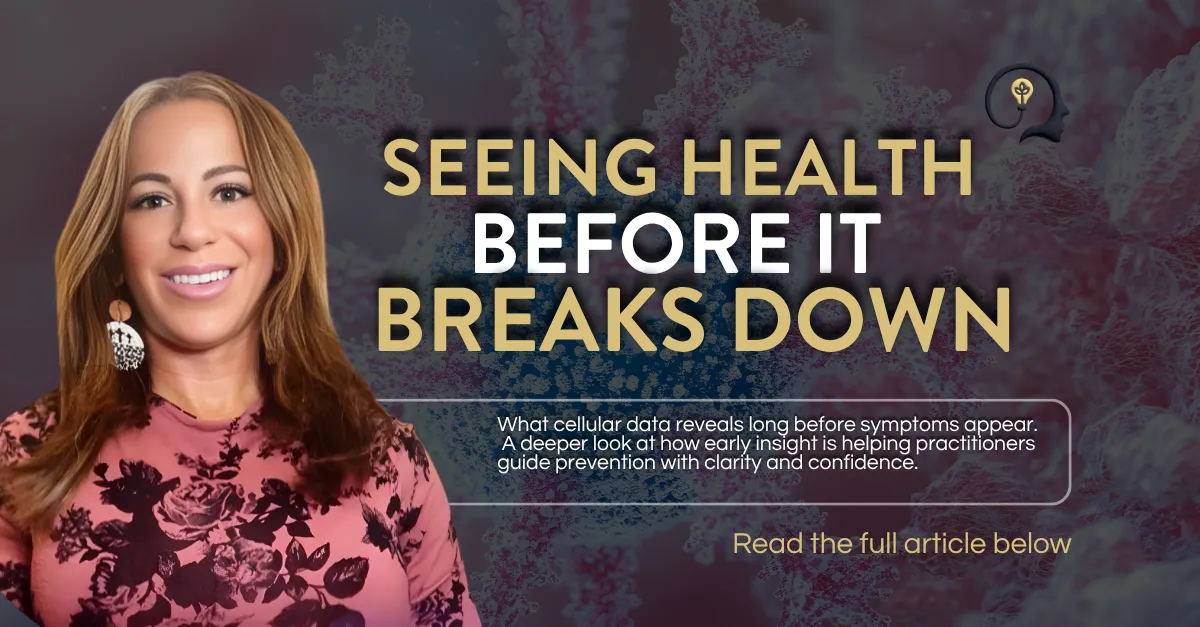
How Epigenetic Scanning Saved Debra’s Life and Why This Technology Could Be the Future of Medicine
Why Lab Tests Are No Longer the Full “Truth.”
What if the body you thought was healthy was quietly screaming for help?
Debra Crystal, an exercise physiologist and marathon trainer, was checking all the right boxes: clean eating, regular workouts, and a supplement regimen. But something still felt off.
The wake-up call came in the form of a 30-second epigenetic scan that delivered a shocking result: her cellular health was equivalent to someone who smoked a pack of cigarettes a day.
"It was a lie detector," she testifies.
That moment cracked open a new chapter in Debra’s health journey and ultimately, her life mission.
What started as a personal quest to feel better became a career shift that would lead her to help thousands. Debra found answers in an innovative device that doesn't just test symptoms, it measures what's happening at the cellular level. The results transformed her health, her fertility, her energy, and her future.
This is not just her story. It’s a call to the healthcare industry to rethink everything we know about prevention, testing, diagnosis, and what it really means to be "well."
Going from Rock Bottom, transformed into Purpose
Before she became a pioneer in the functional medicine movement, Debra was a trainer, athlete, and wellness enthusiast. But her journey into holistic health wasn’t inspired by her achievement…
It was born out of survival.
"I have nine years of sobriety. Addiction really destroyed me. Getting sober was the start, but rebuilding my health gave me life," said Debra Crystal.
Her formal background in exercise physiology gave her a foundation in fitness and recovery, but nothing prepared her for what she would discover next.
At a time when she felt stuck, burned out in her pharmaceutical sales career, seeking deeper purpose, a chance encounter changed everything.
"I ordered an Uber and met Greg Waller, a senior partner with this company. He handed me his card and said, 'Debra, do not lose this card. It’s worth a million," said Debra Crystal.
That introduction led her to discover an advanced epigenetic scanning device. And within weeks, she quit her job and began building a business around what would become her life’s mission.
Building a Wellness Profit Center
Debra now runs a consulting and distribution business centered on this groundbreaking technology. She calls it her "Wellness Profit Center," a business that helps both individual clients and healthcare providers access epigenetic scanning and personalized supplementation.
"It measures antioxidant levels, specifically carotenoids, in just 30 seconds. It gives you a cellular health score that reflects oxidative stress, the root of most chronic diseases," said Debra Crystal.
This scan was originally developed for the Moran Eye Center to measure macular degeneration, but was soon recognized for its broader health potential. Backed by institutions like Yale Cancer Center and the NIH, the technology was refined from a lab-sized instrument to a pocket-sized scanner.
The scan helps users make real-time, data-backed decisions about their health. It gamifies the process of wellness and shows measurable improvement over time.
For Debra, the transformation was personal.
"When I first scanned, my levels were so low, despite training for the Boston Marathon. But after I started the recommended supplements, my score went from smoker-level to the 80,000s. I’ve never felt better," said Debra Crystal.
Epigenetic Scanning is Breaking Barriers in Medicine
Debra's journey wasn't without challenges.
"Most people have no idea this technology exists. We're still under the radar," said Debra Crystal.
She had to educate not only consumers but also skeptical doctors entrenched in a reactive, insurance-based model of care.
"A pediatrician told me he quit because he couldn’t meet patient quotas. Doctors are tired. They want to practice real medicine, not rush people through appointments," said Debra Crystal.
There were logistical hurdles, too: regulatory compliance, scaling the technology, and standing out in a market flooded with low-quality supplements.
"We have over 90 peer-reviewed studies backing our product line. It’s listed in the physician's desk reference. This isn't a trend. It’s science," she shared.
It Changed Her Life and Her Miracle Baby
Debra's own transformation is profound. After being told it was unlikely she’d carry a full-term pregnancy, she now has two healthy children.
"When my score reached the 60,000s, I got pregnant immediately. My daughter’s name is Mira…short for Miracle," she shared.
She’s worked with clients of all ages, from children with behavioral issues to seniors seeking energy and vitality.
And the data speaks volumes:
A single scan costs $20–$25 yet can generate $70K+ annually in passive revenue for providers.
Clinics see improvements in patient biomarkers and behavior when they introduce this measurable approach.
Many practitioners use the scanner as a conversation starter, a way to talk nutrition, supplements, and longevity with clarity.
What Every Wellness Leader and Health Practitioner Needs to Know
Debra's mission is bigger than her own.
She wants to shift healthcare from symptom-chasing to cellular prevention.
Here’s what she tells clinic and healthcare providers:
1. Stop waiting for symptoms.
Most diseases start at the cellular level years before they show up in labs.
2. Measure what matters.
Antioxidant levels and oxidative stress are real, trackable biomarkers. If we measure them, we can manage them.
3. Say goodbye to supplement guesswork.
Patients are already buying supplements, often ineffective ones. Give them personalized, proven protocols and prescriptions.
4. Create revenue without burnout.
This model gives doctors more income, more impact, and more time.
5. Empower patients.
When people see their scores, they get motivated. Data drives change.
What’s Next for Debra’s Vision
Debra is preparing for the next wave of innovation. A new scanner the size of a hockey puck will soon hit the market, capable of analyzing biomarkers like the microbiome, collagen, and more.
"It’ll connect with wearables and create a digital twin for each patient," she said..
She’s also expanding into India, her husband's homeland, as her company’s parent brand enters that market.
The Future of Preventive Care Is In Our Hands
Debra Crystal's story isn't just about one woman beating the odds. It's about the possibility that a better healthcare system already exists. We just need to embrace it.
This technology didn’t replace traditional care. It enhanced it. It gave Debra information that her doctors couldn’t yet access. It empowered her to make changes that transformed her body, her energy, her fertility, and her future.
"You don’t have to be perfect. You just have to be aware. And willing to look," said Debra Crystal.
In an industry too often driven by insurance codes and burnout, epigenetic scanning offers a new path: measurable, preventative, personalized care.
It’s time to move from reactive medicine to real health leadership.
Want to be featured in MBNews?
Join the movement. Share your visionary work or nominate another wellness leader who deserves the recognition. Comment down below or apply here.
Let’s elevate the future of healthcare, together!