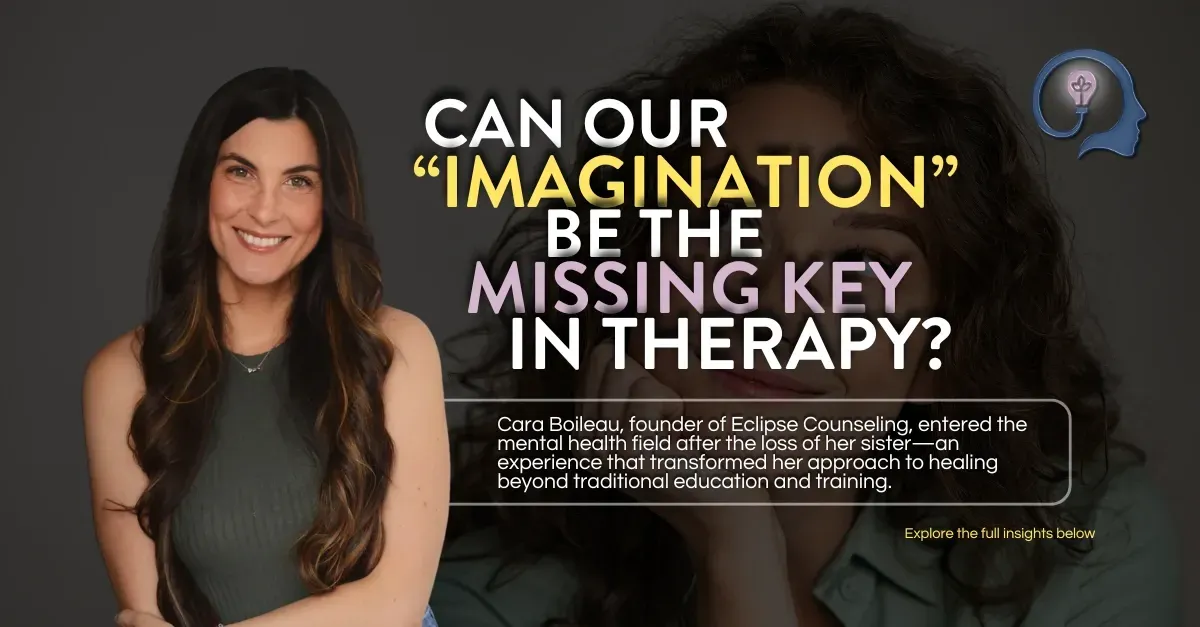
How One Therapist Turned Loss into a New Model for Emotional Healing
What happens when the life you planned is interrupted by unimaginable loss?
Most therapists don’t start their careers in grief.
But for Cara Boileau, loss wasn’t just something to process; it was the beginning of a new path.
While finishing her marketing degree, Cara’s world was turned upside down by the death of her sister. The experience cracked open deeper questions about purpose, connection, and what it really means to support others through pain.“I wanted to honor her spirit in a way that felt meaningful,” Cara shared. “I couldn’t help her while she was here, but I could help others now.”
That moment sparked a shift, from student and spiritual seeker to therapist and guide.
Drawing from years of exploring Reiki, herbalism, and emotional wellness, Cara realized traditional talk therapy didn’t always reach the root. She envisioned something more expansive, therapy that integrated the mind, body, and imagination.
Today, her private practice, Eclipse Counseling, offers exactly that: a space where clients feel safe to explore their emotions, reconnect with their truth, and move toward authentic wholeness.
This is the story of how one therapist turned personal loss into a new model for emotional healing.
How grief, creativity, and a lifelong pull toward healing led Cara to her calling.
Before becoming a therapist, Cara Boileau’s life was a mosaic of service and self-discovery. She worked as a bartender, nanny, and dabbled in marketing, jobs that paid the bills but didn’t feed the soul. Behind the scenes, though, something deeper was always unfolding. She was studying Reiki, exploring herbalism, and nurturing an inner call toward healing, though she didn’t yet know what shape it would take.
Then everything changed.
While finishing her undergraduate degree, Cara’s sister passed away. The loss brought her face-to-face with grief in its rawest form, and with it, an urgent need to redefine meaning, purpose, and connection.
“Grief is a tender place,” Cara explained, “but it also opens you up. I realized I wanted to honor my sister by serving others the way I couldn’t serve her.”
Rather than follow a career in marketing, she pivoted toward therapy, not just as a profession, but as a way to turn sorrow into service. Her own lifelong relationship with therapy had already shown her its power. But she didn’t want to replicate the clinical, detached methods she saw in conventional settings.
She wanted to create something that felt human.
In that moment of profound loss, Eclipse Counseling was born, not in name, but in intention. A place where grief could be honored, emotions could be explored, and healing could feel expansive, imaginative, and real.
Building a practice where emotion, imagination, and authenticity lead the way.

When Cara founded Eclipse Counseling in 2022, she wasn’t trying to reinvent therapy; she was simply trying to make it feel more true.
Her vision was simple, but bold: to create a therapeutic space where people could reconnect with their emotions, explore their inner worlds, and safely integrate the different parts of themselves. A space that honored not just thoughts and behaviors, but imagination, intuition, and embodied wisdom.
At the heart of her work is the belief that healing happens when people feel seen, not systemized.
“A lot of my clients have been to therapy before,” Cara explained. “They know how to recognize unhelpful thoughts. But what they’ve never had is the space to go deeper,to feel what those emotions are trying to say.” Cara describes herself as an integrative therapist, meaning she blends various modalities to support the whole person. While many therapists lean heavily on cognitive tools, she uses imagination and emotional metaphors to guide clients into deeper awareness.
Visualization is a core pillar in her sessions. Instead of solely talking through issues, she helps clients paint mental pictures, create symbolic "containers" for emotions, and even explore the physical sensations that many avoid.
“Anxiety is a trance,” she shared. “It’s imagination used against us. So why not use that same imagination as a force for healing?” This philosophy extends beyond technique. Cara’s sessions are deeply relational and non-hierarchical. She rejects the idea of therapist as “expert,” positioning herself instead as a guide, someone walking beside her clients, not above them.
“I always tell my clients, I’m not the expert on your life,” she said. “You are. I’m just here to help you come back to who you already are.” Eclipse Counseling doesn’t follow a one-size-fits-all model. Each session is uniquely tailored. For Cara, healing is not about ticking off symptoms; it’s about helping people rediscover the truth of who they are.
And that’s what makes Eclipse so different. It’s not therapy that pushes people toward “progress.” It’s therapy that meets people exactly where they are and invites them to imagine what healing could look like from the inside out.
Leaving structure behind and learning to lead in her own way.
While Eclipse Counseling was founded with vision and heart, the road to building it wasn’t without resistance, internally and externally.
Like many practitioners, Cara began her clinical journey in community mental health, working with youth and individuals living with severe and persistent mental illness. The experience was valuable, but the system felt restrictive. Sessions were time-limited. Treatment plans were rigid. And healing was often reduced to metrics and paperwork.
“In community mental health, everything is structured,” she shared. “You can only see a client for a certain number of sessions. But that doesn’t serve the client. People don’t heal on a timeline.” The decision to leave that system came with risk, but also relief. Creating her own practice meant she could finally tailor therapy to the client, not the model.
Still, entrepreneurship brought its own set of challenges, especially as a neurodivergent business owner.“Being a neurodivergent entrepreneur can be its own level of chaos,” Cara admitted. “Staying organized, finishing what I start, it doesn’t come naturally.”
What helped her move forward wasn’t doing it all alone. Instead, she leaned into community, collaboration, and outsourcing. She joined a therapist co-op where members support each other’s growth, share resources, and refer clients intentionally based on energetic fit,n ot just availability.
Accountability became a strategy, not a punishment. Instead of forcing herself to fit into rigid business molds, she began working with creatives, strategists, and web designers who could help her build sustainably, without burning out.
Through it all, she kept returning to her purpose: connection, imagination, and helping clients come home to themselves.
And when the work felt overwhelming, she reminded herself: she wasn’t doing it to fit in, she was doing it to create something that never existed before.
What happens when therapy stops being clinical and starts being real?

For Cara, success isn’t measured in checklists or session limits. It’s measured in moments of clarity, connection, and deep self-recognition.
Her clients aren’t just learning how to manage symptoms; they’re discovering who they truly are.
“The relationships I build with my clients aren’t one-sided,” she shared. “Yes, I’m guiding them, but every time I share wisdom, there’s a version of me that needed to hear it, too.” This relational approach creates a unique dynamic, one that feels less like a professional transaction and more like a collaborative return to wholeness. Cara sees her work as a sacred space where clients can explore the parts of themselves they’ve long ignored, hidden, or been taught to suppress.
Many of her clients stay in therapy long-term, not because they’re stuck, but because they’ve found a space where growth feels nourishing instead of performative.
They begin to express their truth. Set clearer boundaries. Reconnect with their bodies. And in many cases, heal generational or spiritual wounds that traditional therapy never touched.
Cara’s approach has been particularly impactful for individuals navigating trauma, identity, intimacy, and self-trust, the kinds of issues that don’t fit neatly into diagnostic categories.
And now, she’s deepening that work further.
She recently began training in Internal Family Systems (IFS), a method rooted in the idea that we all have different “parts” inside us, each carrying messages, memories, and unmet needs. Instead of labeling these parts as broken, IFS invites us to listen, understand, and integrate.
“There is no bad part,” Cara said. “All parts of you are welcome. And when you understand their purpose, you can move forward in a way that feels whole again.”
Through Eclipse Counseling, she’s creating a ripple effect, not only helping clients heal but encouraging them to live with deeper authenticity, self-compassion, and inner alignment.
Because when therapy becomes a mirror for your truth, the transformation doesn’t end at the door.
What the therapy and wellness field can learn from Eclipse Counseling.
Cara’s work is personal, but its lessons ripple far beyond her own practice. At a time when the mental health industry is stretched thin and too often reduced to numbers, her integrative, imagination-led approach offers a reminder: therapy is about people, not protocols.
“Clients don’t heal on a timeline, and they don’t need a hierarchy,” Cara emphasized. “They need space to be themselves, fully and authentically.” Her philosophy serves as a call to action for the next generation of practitioners. Here are five takeaways she hopes others in the industry will embrace:
1. Healing isn’t linear, and it can’t be rushed.
Rigid treatment structures and session limits may serve systems, but they don’t always serve clients. Deep work requires flexibility, patience, and trust.
2. Emotions are not obstacles; they are teachers.
Rather than pushing emotions aside, Cara invites clients to see them as messengers with wisdom. This reframes therapy from symptom management to self-discovery.
3. Imagination is a tool for liberation.
The same force that fuels anxiety can also fuel healing. By creating safe “containers” through visualization and metaphor, clients unlock new ways to process pain.
4. Therapy should be collaborative, not hierarchical.
Clients aren’t problems to be fixed, they’re people to be guided. When the relationship is built on authenticity and mutual respect, transformation becomes sustainable.
5. Practitioners need community, too.
Therapists, healers, and wellness professionals thrive when they lean on each other for support, accountability, and shared resources. Healing is collective work.
Cara’s message is clear: if the mental health and wellness industries are going to evolve, they must move toward integration, authenticity, and relationship-centered care.
Expanding the vision of Eclipse Counseling.

For Cara, Eclipse Counseling isn’t a finished product; it’s a living, breathing practice that grows alongside her clients. The next chapter is all about expansion, not just in scale, but in depth.
One of her immediate projects is adding a blog to her website, a resource hub where anyone, whether they’re in therapy or not, can access tools, reflections, and conversations about healing. This effort reflects her belief that therapy doesn’t only happen in sessions; it begins with accessibility and awareness.
She is also pursuing advanced training in Internal Family Systems (IFS), a modality that aligns perfectly with her integrative philosophy.
By helping clients explore and welcome their inner “parts,” Cara is expanding her capacity to guide people through trauma, identity challenges, and the complexities of intimacy.
Long-term, she’s preparing for certification as a therapist in Florida, which will allow her to deepen her specialization in trauma and intimacy work, a path she believes is vital for clients who carry wounds around self-expression, relationships, and safety in their bodies.
The future of Eclipse Counseling is rooted in this principle: more access, more depth, and more authentic integration.
Because healing isn’t about fixing, it’s about becoming whole.
Cara Boileau’s story reminds us that healing often begins in the shadows of loss, but it doesn’t end there. What she has built with Eclipse Counseling is more than a private practice; it’s a philosophy, a lived commitment to seeing people as whole, even in their most fragmented moments.
By weaving together imagination, body awareness, and relational safety, Cara is redefining what therapy can feel like. She’s proving that emotions are not problems to be solved, but teachers to be honored. And in doing so, she offers a model for an industry that too often rushes, restricts, and reduces healing to numbers.
Her work matters because it calls us back to authenticity. To integration. To the radical idea that every part of us, even the ones we’d rather hide, deserves a seat at the table.
For therapists, healers, and wellness leaders, Cara’s journey is a powerful reminder: transformation is possible when we dare to step outside convention and create space for wholeness.
Because in the end, therapy isn’t about sessions or structures, it’s about the courage to imagine a new way forward.
—-----------------------------------------------------------------
Join the MBNews community as we spotlight visionaries like Cara who are reshaping health and wellness from the inside out.
Want your story featured? Apply here!.
Share this article with a colleague or friend who believes healing should be as human as the people it serves.

